Wednesday, August 31, 2011

THE BROTHERS COEN GO INSIDE LLEWYN DAVIS


2011 marks the first year since 2007 that Joel and Ethan Coen don't have a film being released, but that doesn't mean they haven't been hard at work on their next project. Rumor had it months ago that the two greatest living filmmakers (or so says I) were working on a film revolving around the '60's New York folk music scene. Now, according to Variety, it appears that rumor has been confirmed, and the new film will be titled Inside Llewyn Davis.

Details on the plot are scarce, but Badass Digest has a nice write-up on who the film may have been influenced by (not based on - the screenplay is an original work by the brothers). If you've never heard of Dave Van Ronk (I hadn't before today), head on over there and read about a man you'll probably be hearing more about in the next year or so.

StudioCanal will co-finance the movie, and Scott Rudin, who has worked with the Coens on True Grit and No Country for Old Men) will produce. No word yet on when Inside Llewyn Davis will be released, or even a start date, but my guess is we'll be seeing a trailer for the film around this time next year. I'm getting giddy about it already.

Friday, August 26, 2011

TEFB TRAILER: THE RUM DIARY


I never thought I'd say this, but I'm awfully tired of Johnny Depp. When he's not acting in a tired, bloated franchise or an odd remake, he's turning in incredibly boring performances in dreck like The Tourist and disappointments like Public Enemies. It's been a long while since I've been interested in anything Depp has done (I find myself watching Ed Wood, a movie almost two decades old, when I need to remind myself of why I love the man's work to begin with), and I was starting to think that all he has left in him is an overdone Keith Richards impersonation.

Today sees the release of the trailer for The Rum Diary, a film so long in development I had forgotten about it. Production on the project began in March of 2009 and wrapped in the summer of that year. I remember seeing the first official still from the movie not too long after that. To be honest, the last time I thought about The Rum Diary, I was sure it was going disappear into oblivion or worse - go straight to DVD.

Anyway, in this pseudo follow-up to Fear and Loathing in Las Vegas, Depp again plays Paul Kemp, another Hunter S. Thompson alter-ego. I'm steering clear of any plot details, simply because I want to walk into the movie fresh (as fresh as possible after watching a two minute trailer), but from the looks of it you'll be seeing Depp drinking and then getting it on with Amber Heard. Ah, the life of a gonzo journalist. You can find the synopsis over at ETonline, but watch the trailer embed below. Entertainment Tonight's video player forces you to take a survey about orange juice before you can watch the footage. Ugh.

The Rum Diary opens October 28. 

Sunday, August 14, 2011

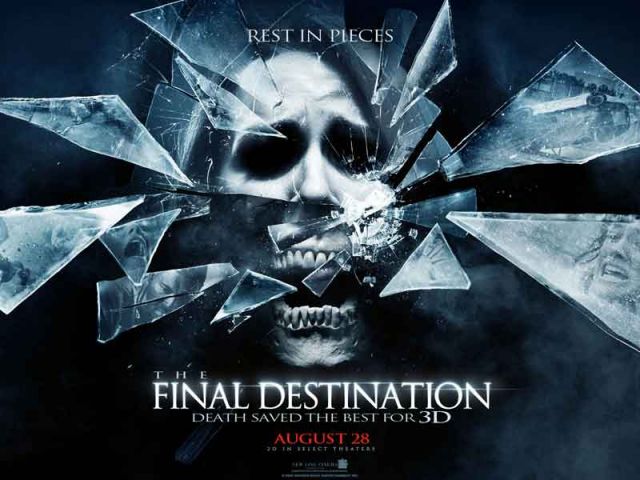
TEFB REVIEW: FINAL DESTINATION 5


Directed by Steven Quale


Starring Nicholas D'Agosto, Emma Bell, Miles Fisher

I'm a Final Destination virgin. There, I said it. While I'm familiar enough with the franchise to know that it's really nothing more than a series of Rube Goldberg set-ups designed to showcase increasingly crowd-pleasing character deaths, I've never actually seen one of these films from beginning to end. It's not that I'm opposed to them, it's just that I imagined myself above such simple concepts. And, even though I'm a big fan of the Friday the 13th series, watching a film series that features vapid teens succumbing to their ends in various ways just seemed...oh f*** it. I got snobby on myself.

Anyway, turns out Final Destination 5 is the second time this summer I've found myself having a great time walking into a film with four prequels, none of which I have seen. Between this and Fast Five, I'm going to have to stop taking going to the movies so seriously. Because a movie like Final Destination 5 doesn't want you to take it seriously.

That's not to say it doesn't want you to take the experience of it seriously. Director Steven Quale co-directed Aliens of the Deep (the shot-in-3D-weird-effing-sea-creatures documentary), with THE James Cameron, and was second unit director on Avatar (directed by THE James Cameron), the most successful movie (3D or otherwise) of all time. The man is damn determined to make sure you recognize that making an audience squirm, gag, hoot, holler, and laugh at the same scene requires effort, and to do it in more than two dimensions requires the proper use of cameras designed to shoot in three. He's damned determined to make sure you recognize this but, the question is, does he, and, more importantly, does it work? The answer is: yes. And...yes.

FD5 begins as Sam Lawton (the blank faced thespian Nicholas D'Agosto) has a premonition while on a corporate team-building retreat for a local factory. The premonition involves a bridge collapsing into nothingness as the bus he and his friends were on follows suit. Armed with this sudden foresight, Sam proceeds to rescue a who's-who of stock horror characters from the bus - his innocent girlfriend  (Emma Bell), the sexy narcissist (Jacqueline MacInnes Wood), the Black Guy (Arlen Escarpeta), the big-boned perv (P.J. Byrne), his best friend (Miles Fisher), his best friend's girl (Ellen Wrote), and the "obviously influenced by The Office" boss (David Koechner, in a very funny but short-shafted role).

 For the most part, 5nal Destination couldn't care less about its characters. At least at first. Quale does an admirable job of setting up the "sure to die" cursory cast - you know at least the fat guy and vixen are going to get it soon in the film, simply because they're the worst people in the world - and spends a little bit of time with Sam the Hero and his Princess - the former of who is a part-time chef with a chance at an apprenticeship at a restaurant in Paris, the latter of who is the love of his life, and someone he wants to move to The City of Love With. It's all perfunctory, and generally not very interesting. Then the set pieces happen.

Beginning with the elaborate bridge collapse (which, by the way, the film never tops), Final Destination 5 stages some truly impressive exercises in the macabre. Planning on getting LASIK surgery? Consult your optometrist before this movie. Gymnast? Skip FD5. Acupuncture curious? Stick with massages from your inexperienced girlfriend. Quale excels at creating some truly uncomfortable  sequences. A scene where a gymnast dances her feet around an unnoticed pointy-side-up screw on a balance beam is a nicely edited few minutes of cringe-inducing tension, which climaxes in the film's grisliest death. The pattern is repeated a few times throughout the film, and in this way FD5 is no different than your typical Halloween-esque slasher film. Instead of waiting for the masked killer to jump out of the shadows to give someone a machete facial, we're watching to see how the machinations of the invisible hand of death result in the same outcome.

Since death is not seen in the film (but certainly felt), the screenwriters throw a little twist into the proceedings. After all, a series of complicated and gruesome set-pieces is fun, but not a film. In Final Destination 5, it turns our fatally doomed characters can exchange their lives for others. If they kill another person, giving death their debt, they're allowed to live. This leads to a moral quandary explored by the screenwriters with all the depth of a kiddie pool, but it's an interesting change of pace nonetheless, especially when actor Miles Fisher - who looks like Tom Cruise's body grew all the way up to nose, then the top half of his face decided to become Jason Schwartzman - gets to stretch his acting range from A to B. Fisher's not a good actor (none of these people really are, actually), but he attempts some scenery chewing towards the end of the film, which is surprisingly fun to watch.


Overall, Final Destination 5 is a harmless, but well-crafted fright-fest that will succeed with late-night audiences. If the previous entries are this much fun to watch, I may just go from Final Destination virgin to Final Destination slut faster than I can take my pants off.


Wednesday, August 10, 2011

TEFB REVIEW: 13 ASSASSINS

review by Mark Pezzula

Directed by Takashi Miike


Starring Koji Yakusho, Goro Inagaki, Takayuki Yamada

I realize that "damn near perfect" is in no way an acceptable, scholarly assessment when it comes to film criticism, but it's hard to think of any other way to describe Takashi Miike's samurai epic 13 Assassins. Some films just hit every note they strive to hit impeccably, and while there may be the occasional out-of-tune instrument or an odd tempo, the movement as a whole is a strong, splendid, and arresting piece of work that doesn't appear to have any flaws. The notes hold the hole thing together.


13 Assassins
begins as the age of the samurai is ending, in late 19th century Japan. It contains a simple story, and one with no murky moral area. The villainous Lord Naritsugu (Goro Inagaki) rules over his land with clearly defined craziness. He rapes the women at will, kills whole families indiscriminately, and, in the film's most disturbing scene, has cut all of the limbs off of a peasant woman and kept her as his slave, only to toss her out on the road when he finished with her. As the half-brother of a local Shogun, Naritsugu treats his servants and people sadistically, like a spoiled child of Hades. Sir Doi (Mikijiro Hira), a low-ranking local official, recognizes the evil inherent in Lord Naritsugu, and plots the insane man's death so that it may be at the hands of one of twelve chosen samurai. The film chronicles the recruitment of these samurai during its hour or so, and then spends the rest of the film displaying one of the longest, bloodiest, best-choreographed action sequences you're ever going to see.

More on that action sequence later. First, most of the samurai chosen to complete this quest are glossed over by the screenwriters and Miike, and are characterized either by a specific talent they're asked to use during the battle with Naritsugu's army (one is an expert swordsman, two are explosives experts) or a personality trait they exhibit (one samurai joins the group in order to seek redemption for a life of gambling and womanizing). The last assassin to join the group, Kiga Koyota, is a hunter caught up in a woodland trap. While unconnected to the events, Koyota agrees to follow the men into battle. The fact that most of these characters aren't well defined isn't necessarily a criticism of the film, just an observation. The screenplay makes sure they're more than just interchangeable faces, but doesn't spend time making sure we feel as deeply for each one of them.

The one we feel the deepest for is their leader, Shinzaemon (Koji Yakusho), who gets the most screentime. As a samurai past his prime, it is understood that this will most likely be his last quest, and while Naritsugu is his primary target, Shinzaemon has an opposite number in the form of his former friend, and current right hand of Lord Naritsugu, Hanbei (Masachika Ichimura). While Shinzaemon fights for the good of the people Naritsugu oppresses, Hanbei is loyal only to the Shogun, and vows to protect his master until the very end.

It is this theme of fighting for what one believes in that is explored in a myriad of ways throughout 13 Assassins. It's a theme as old as storytelling itself, but the film never feels like it's treading over well worn ground. The movie is old fashioned in that it delineates clearly between good and evil, and good guys have only one goal: to take down the bad guy. The heroes are righteous, the villains odious. Miike aims to distinctly portray Naritsugu as an abomination, so that the plight of the men hired to assassinate him becomes purely virtuous. It is this simple representation of right versus wrong, good versus evil, honor versus loyalty that makes 13 Assassinsa a breeze to follow, allowing Miike to impress with a brisk pace, gorgeous cinematography, and well-choreographed fight scenes, and lets the cast have fun acting acting out the two sides. Goro Inagaki is the biggest pleasure in the film, performance wise. Naritsugu is a villain for the ages, and Inagaki inspires hatred in not only the characters, but also the audience. The movie is spent wanting to see this monster dispatched, but enjoying every menacing moment he's on screen.

Takashi Miike is known for a few things, the least of which is his prolific body of work. His filmography runs the gamut - everything from Westers (Sukiyaki Western Django) to teen horror movies (One Missed Call) to surrealist domestic comedy (Visitor Q) to a horror musical (Happiness of the Katakuris). With each genre, Miike has displayed a penchant for the bizarre, and a compulsion to portray the odd and grotesque in boundary pushing ways (see his 1999 horror film Audition). With 13 Assassins, however, Miike is more restrained, and the movie is all the better for it. While the director doesn't completely eschew everything odd from the film (Koyota may or may not be an immortal demon; the limbless girl is shot in agonizing detail), 13 Assassins is by far his most accessible and entertaining film.

Most of that entertainment comes from the last forty or so minutes of the movie. I promised myself I wouldn't just fill this paragraph with hyperbole, but I'll be darned if 13 Assassins doesn't have one of the best extended action climaxes I've ever seen in a film. When Lord Naritsugu arrives in a town renovated by the samurai to be one giant booby trap, the film escalates into a gigantic fight between our heroes, who number a baker's dozen, and two-hundred of Naritsugu's men. As each of the assassins has spirit enough to fight until the end, they shed much blood through a slice of the sword, buildings rigged to explode, spiked barricades, and flaming bulls (yes, this movie has flaming bulls). Throughout the battle scene, Miike keeps control of the action with well shot choreography, establishing geography, and makings sure the momentum is kept by giving out heroes different things to do. It's amazing work, and there isn't one American action director who couldn't learn a thing or two by watching the scene.

Overall, 13 Assassins is an overly impressive, technically marvelous, yet simple piece of work. It's Takashi Miike's best film so far, and stands alongside the best samurai films (Seven Samurai included) of all time. It's damn near perfect.

Saturday, August 6, 2011

CAPTAIN AMERICA: THE FIRST AVENGER (ERIN G'S TAKE)

Greetings all! Mark here. This week we have a special guest blogger Erin G, who has done us a favor and reviewed the Chris Evans starring Captain America: The First Avenger for us! Her thoughts are below. Enjoy!

Captain America: The First Avenger

The last piece needed before we can get to The Avengers.
   
The superhero story many have been waiting for, begins with the hero to be, Steve Rogers (Chris Evans), trying to enlist in the army for about the fifth time. Although his large array of medical problems has prevented him from being one of the chosen every time. Finally, Dr. Abraham Erskine (Stanley Tucci) discovers Rogers and drafts him into the army to be the subject of his experiment. The experiment that will make him Captain America.

 Negative things:
Cheesy to the max. A few of the lines were almost painful to sit through. When asked why he hasn’t danced with a woman, a puny Steve Rogers replies, “I’m just waiting for the right partner.” Which is later repeated by Peggy Carter (Hayley Atwell) after Captain America’s first rescue mission. One or two of these moments is to be expected. However they are frequent throughout the movie. Enough to make any writer grit their teeth against an outburst.

The cheese would also be more edible if the action promised by the previews hadn’t started an hour and ten minutes into the movie. When it finally did start it was amazing (more on that later) but there wasn’t enough. No giant battles that lasted for the appropriate amount of time, just snippets of Rogers throwing his shield and what not. Even the ending battle scene between, villain Johann Schmidt/Red Skull (Hugo Weaving and the hero was short lived.

Positive flipside:
The action was amazing! There wasn’t nearly enough and it started way too late, but it was very enjoyable. The shield throwing was seriously cool and the fight scenes though brief had everyone hoping it would last so we could actually enjoy some more of the movie. It was almost as though they wanted the film to be more character driven so they didn’t want to overdue do the action. If they had cut out some of the corny blah and put a little more action in its place they could have had a delightful blend of character/action at the wheel.

**SPOILERS AHEAD!**

Character death! Woohoo! It was a rare moment of non cheese, but there is one heart wrenching moment when Captain America’s best friend, James Buchanan ‘Bucky’ Barnes (Sebastian Stan), falls to his death. You think Steve is going to reach out and grab hold of him just in time, but no.

It isn’t something one cheers for but it’s something one, in a morbid fashion, hopes for. An audience isn’t there to be cheery through an entire movie. They want to be moved. Character deaths tend to be just the ticket in moving an audience to feel. Perhaps the writers were trying to balance all of their corny lines with one good kick to the stomach. It didn’t work but it was still a good low for the Captain.

**End Spoilers**

In most movies one can expect a character to change once they gain power. With the power comes the giant pride, and then after that comes the fall. In the fall they realize how they must use their power for good, and from this the hero is shaped. Not with Captain America. In a pleasant twist of the normal arc, Steve Rogers remains the same guy once he is powered up. He goes on a stint of putting on shows for children (where he earns his famous moniker), but it’s only because he’s following the orders of Colonel Chester Phillips (Tommy Lee Jones).

In the end the character is a brave man who only worries about fighting for what he believes in rather than dwelling on his own abilities to actually do the fighting.

Acting negatives and postives:

The cast in general was alright. With the exception of Tommy Lee Jones who outshined everyone by far. The moments Tommy got the screen were definitely the best moments acting wise.
Evans’ performance as the title character was good enough. The only thing to be mentioned is the beginning with the CGI body. Really weird. I suppose the restrictions put on an actor through that process could have an effect on the role but since I’ve never experienced that I’m only guessing. He did much better once they put him back to his normal body type.

Red Skull was not hate-able. Dislikable but no one was gripping their seat in anticipation of his death. Hugo Weaving was believable he just didn’t deliver a performance worthy of audience hatred. That’s really all that can be said.

Dominic Cooper is another lukewarm actor. He was no Tony Stark, which is what the audience was expecting. While it was neat to see the founder of Stark Industries, it could be very difficult to bring someone to play Robert Downey Jr.’s father. He’s an amazing actor who plays a really fun role. One would need to at least match his energy in order to play his ‘elder’. Cooper fell just short.

Going on the T.E.F.S. rating I’d give this film E and a quarter. It droned on too long before getting to the action. While the action was sweet there just wasn’t enough of it to earn the film an F. Then there was the cast made up of actors who didn’t suck but didn’t make me want to see them again.
They should have had Joss Whedon write and direct all of the marvel movies. Captain America  wouldn’t have gone this way, and Spiderman and The Hulk wouldn’t have needed reboots. At least there’s next summer to look forward to!

Tuesday, July 19, 2011

TEFB REVIEW: HARRY POTTER AND THE DEATHLY HALLOWS PART 2

reviewed by Mark Pezzula


Directed by David Yates


Starring Daniel Radcliffe, Emma Watson, Rupert Grint


It doesn't matter if you're a fan of Harry Potter or not; with the final book in one of the most successful series of novels in literary history, J.K. Rowling unarguably nailed the ending of her story, which was first published fourteen years ago. While far from perfect, Rowling's Harry Potter and the Deathly Hallows was pretty much everything a fan could ask for and then some. Despite a middle that drags like an ogre's belly, the seventh and last book of the series tied up loose ends, provided a satisfying conclusion for its characters, and dealt with themes of death and resurrection, redemption, loyalty, friendship, and forgiveness in a thoughtful and entertaining manner. The only question left after fans finished the book feeling fulfilled was this: would the last film in a series of movies just as successful as the books they followed stick its landing in the same way?

The answer is: yes, it does. With reservations, and a caveat that Harry Potter and the Deathly Hallows Part 2 does NOT work as a stand-alone film, the final cinematic journey of Potter and pals provides folks who have followed this saga for the last ten years with a finale that makes one's commitment to the series feel worth the time and money put into it. While the film stumbles a bit when its toes first hit the landing pad, by the time the balls of its feet touch down all the shakiness has left its legs.

But first: the aforementioned caveat. The Harry Potter films haven't worked as stand alone pieces of cinema since at least The Order of the Phoenix, the fifth in the series. That's when director David Yates came on board and was hired to finish what Chris Columbus started and Alfonso Cuaron and Mike Newell continued. Those coming in blind to Phoenix and each film thereafter would find the story almost impossible to follow. By that time you were either committed as a fan or not.

It may seem obvious that the second part in this two part film feel like a simple continuation of its predecessor - after all, The Lord of the Rings trilogy recently proved that audiences could handle a continuous story told over three films. But those movies each had three distinct acts, and while you can't watch one without feeling the effects of the others, each film supports itself. Deathly Hallows Part 2 has no beginning. In fact, I don't even know if it has a middle either. After starting off with literally the last scene of Part 1, Part 2 simply continues where the last one left off. At least The Two Towers and Return of the King feature opening scenes reminding the audience of the stakes and, at the same time, allow the viewer to find their footing in the story. Harry Potter and the Deathly Hallows Part 2 simply begins like we never stopped watching the one before it. It's disorienting, and the first twenty minutes of the film struggles with an awkward pace. Once it finds its rhythm, though, and the audience gets their bearings, the film becomes engaging, thrilling, and moving, despite its lack of plot.

What little plot there is involves Harry (Daniel Radcliffe) and his best friends Ron (Rupert Grint) and Hermione (Emma Watson) searching for the remaining Horcruxes - trinkets or objects villain Lord Voldemort (Ralph Fiennes) has injected pieces of his soul into. While the three of them journey into the heart of Hogwarts to find these objects, the rest of the school and the adults who run it are tasked with protecting their beloved institution from Voldemort and the Death Eaters - minions of the Dark Lord sworn to find Potter so their master can kill him.

By the very nature of being a Part 2, Deathly Hallows 2/2 is all pay-off. We witness what comes of Ron and Hermione's passive/aggressive flirting, what became of Dumbledore, and what was really going on with Professor Severus Snape. While the middle films in this series dealt with the hardships any normal student would go through (unrequited love, vicious rumors, stern authority figures), there's none of that here. The stakes are as high as they ever have been, and the lives of thousands of students are on the line. There are no school dances to argue over dates at. Harry doesn't struggle with an increasingly large ego. The only obstacle Harry faces in Deathly Hallows Part 2 is death. The death of his friends, his loved ones, and ultimately of himself.

It's thematically dark stuff, and director Yates ensures a sense of dread and finiteness hangs over the proceedings at all times. The first shot of the film (after the recap of Part 1's last scene) is of a tombstone, and there are some horrific moments of violence in the film (some against characters we have grown to care about).

As much death as there is in the film, Yates shoots most of it as it occurs in the background, or in the periphery of the frame. The battle of Hogwarts (which looks quite gorgeous from a technical standpoint, by the way) takes place around the journey of our three main characters, and they attempt to finish what they've started as they run through pockets of violence that claim the lives of their friends and family. In an odd choice, Yates doesn't dwell on the big deaths, sometimes showing  only glimpses of the bodies of fairly major characters. Where other directors would opt to squeeze tears from every fatality, Yates understands that the audience understands that these characters have paid the ultimate price to not only protect their friend, but to fight a cancerous evil. Their deaths are unwelcome, but honorable.

The effects of these deaths are felt in the performances of the three leads, who have never been better in the series. Daniel Radcliffe began these movies delivering stilted, unconvincing lines and has finished them as a legitimately great actor. Emma Watson and Rupert Grint don't get to do as much in Part 2 as they do in 1, but they still deliver great supporting work, with Grint ending up as the most improved performer over the past ten years.

As many issues as there are with the splitting of Harry Potter and the Deathly Hallows into two parts (I still believe it was unnecessary), there's no doubt that the past six months have seen a satisfying conclusion to what is the other great cinematic achievement of the last twenty years (the other, of course, being the Rings trilogy). It's a marvel that Warner Brothers was able to keep the same actors around for all eight of these films, recruited solid directors to helm them, and to make sure that, just as the books did, the films grow up with the audience. Harry Potter and the Deathly Hallows Part 2 might not be a stand-alone film worthy of revisits by itself, but as a capper to this film series, it works like gangbusters. 

Monday, July 4, 2011

TEFB REVIEW: TRANSFORMERS: DARK OF THE MOON


Directed by Michael Bay

Starring Shia LeBeouf, Rosie Huntington-Whiteley, Frances McDormand


Let's get the positive out of the way first: the third Transformers film features the most spectacular destruction of an American city (with the most spectacular special effects) ever captured on film. The final hour of Dark of the Moon features awe-inspiring set-pieces and Industrial Light and Magic's most impressive CGI work in quite some time. Possibly ever. That being said, despite the scope of the catastrophe; despite the movie's unrelenting final reel; despite the fact that every single dollar spent on the film can be accounted for on-screen, Transformers: Dark of the Moon completely and utterly fails as an action movie on almost every level. It's not a career low for director Michael Bay (that would be it's ugly, mean-spirited, racist, misogynistic predecessor - Revenge of the Fallen, a movie that angered me so much after watching it I felt homicidal), but it's proof that just because the guy knows how to blow stuff up impressively doesn't mean he knows how to compose a great action scene. (Or no longer knows. His run from Bad Boys to Armageddon is actually quite good).

The ridiculous plot (or whatever it's called - it's really just a series of story points filmed to get to the money shots) begins as the film tells us that the real reason 'Murica went to the moon in 1969 was because an alien ship crash landed on it years previously. This ship contained some planet saving technology needed by the Autobots (the good guys, for the layman out there) to ensure a win against the Decepticons (the bad guys) in a long-engaged war.

Fast-forward to present day, where Summer's most annoying hero Sam Witwicky (Shia LeBeouf) is out of college and trying to pimp himself out to various companies in the real world. He needs a job, but no one seems willing to hire him. No one seems willing to believe he's saved the world (two previous times!) either, even though he received a medal from the POTUS and was called on by the US government in the previous film to help them out. If it's one thing this movie features, it's a stupid human race. How do people not recognize Sam Witwicky? None of the characters (even his new girlfriend!) really believe he kept a race of alien robots from destroying the world - TWICE! - and in fact they mostly look down on him. I understand starting the character off at his lowest point, but it's an illogical thing to do considering the events of the last two films, which featured alien robot vs. alien robot action that was only prevented by the actions of Witwicky. .

Anyway, he ends up getting a job at some company run by John Malkovich (the first in a series of unfunny and unnecessary cameos, although Malkovich's is certainly the least offensive one from a lack-of-laughs per minute standpoint) and it's there that he...aw screw it. All you need to know is that at some point, Witwicky is recruited by the government again because...well...I don't know. He's known about the robots for the past four years in another movie and its sequel, I guess.

I know I know. "It's an action movie, the plot isn't supposed to make sense. And besides, we're not supposed to care about it anyway!", you're thinking. Stop it. You're not that stupid. Michael Bay thinks you're that stupid, but you're not. All movies need to have a plot that makes sense in some way or another. Even action movies. And talented directors (James Cameron, anyone?) know how to weave a great story in with great action. Michael Bay has consistently proven (with at least three films in a row, now) that he's either lost the ability to do so or he just doesn't care any more. Slick spectacle that costs 200 million dollars has replaced genuine filmmaking, and Transformers: Dark of the Moon is definitive proof of that. It's the nadir (at least I hope it is) of Summer blockbusters.

Not only does not one minute of story work in the film, but there's also a plethora of unfunny, relentlessly ham-handed cameos in the film. Normally hilarious (in small doses) Ken Jeong shows up for an eye-stabbingly awful ten minutes, playing a coworker of Witwicky's who is in on this whole "alien takeover of Earth" thing the Decepticons are planning. If you think a small Asian man yelling "Deep Wang! Deep Wang!" at Shia LeBeouf while pulling his pants down is gut-bustingly hilarious, then this movie is for you. John Turturro returns as a bat-crap insane conspiracy theorist featured in an incredibly stupid one-on-one with Bill O'Reilly. Also back are Sam's mom and dad, played by Julie White and Kevin Dunn respectively, and while White doesn't have anything nearly as asinine to do as tripping on pot brownies like the last film, they're still the world's most annoying movie parents, and not in a "wow it's funny because it's true" way. If I had Sam Witwicky's parents, I would kill myself. And Alan Tudyk turns up for some reason as a gay German cyber-hacker of sorts. Again, not funny. Michael Bay knows how to blow stuff up. He does not know comedy.

Speaking of blowing stuff up - as previously mentioned, this film blows more stuff up and blows it up better than any film I think I've ever seen. Except it doesn't matter. The amazing pyrotechnics, the jaw-droppingly gargantuan size of the climactic battle, and the latest and greatest computer generated imagery don't mean one darn thing. Besides Bay not giving a crap about his characters (and, by extension, us not giving a crap either), he simply no longer cares about shooting a logical, geographically understandable action scene. Characters start in one place to confront an obstacle or a foe, overcome it, end up in another place, wash, rinse, repeat. There's no reason for why and how these characters do what they do - or at least no logical reason, anyway - they just do it, and in the process Bay throws some indiscernible group of robots at them to fire advanced weaponry at. Most of the time it's impossible to tell who's fighting who or why they're fighting. Bay fills the screen with lots of explosions and metal and screaming people, but that's it. It's mind-numbing, and it's all the complete antithesis of what makes a great action movie. Sure there are a few moments of absolute brilliance (a tower collapse uses both practical, Inception-like set work and some fantastic CG, and a sky-diving scene featuring base jumpers flying around the city is genuinely thrilling), but these moments are context-free and can't fully be enjoyed because they don't engage in being anything other than technically impressive.

During the last hour of Dark of the Moon I kept thinking back to James Cameron's Avatar, a film that also features state-of-the-art technology to depict a massive battle scene. Cameron, first and foremost, makes sure we care about the characters involved. However, he also makes sure to delineate sides - instead of robots who all have an excessive amount of unnecessary features (making them all look the same), we have the Na'vi, with their primitive weaponry and battle tactics, and the humans, whose machinery is practical and not overwhelming to the eye. Characters have motivations and reasons, we know where they are geographically and why they're there, and the action beats compliment the story. None of that is true in this film.

I could go on and on about how annoying Shia LeBeouf is in this film (but to be fair, he does play quite an unlikeable character) or how empty Rosie Huntington-Whitely is as Sam's girlfriend Carly (any Maxim Hometown Hottie has more depth in one glossy photo than Bay gives Carly in the entire running time of the film), but I've already wasted too much space on this film already. Folks, these Transformers movies aren't good. They're soulless, poorly constructed, downright stupid pieces of entertainment. You're better than them. You deserve better than them. No seriously, you do.